8th Pursuit Squadron (8th PS) / 8th Fighter Squadron (8th FS)
"The Black Sheep"
U.S. Army Air Force (USAAF), 5th Air Force (5th AF), 49th Fighter Group (49th FG)
 Background Background
On November 20, 1940 constituted as the 8th Pursuit Squadron (Interceptor) in the U.S. Army Air Corps (USAAC). On January 15, 1941 activated in the 49th Pursuit Group (49th PG) equipped with the Seversky P-35 at Selfridge Field in Michigan with Captain R. D. Van Auken as Commanding Officer (C. O.). On May 23, 1941 moves to Morrison Field (Palm Beach Airport) in Florida.
On June 20, 1941 became part of the U.S. Army Air Force (USAAF). Nicknamed "The Black Sheep". Also known as simply "Black Sheep".
Wartime History
At the start of the Pacific War, prepares for deployment overseas. On January 4, 1942 departs overseas bound for Australia.
On February 2, 1942 arrives Melbourne equipped with P-40E Warhawks.
On February 16, 1942 moves to Canberra Airfield.
On April 1, 1942 Captain Allison W. Strauss became the Commanding Officer (C. O.)
On April 17, 1942 moves to Batchelor Field at Darwin.
On April 20, 1942 the squadron flew their first combat mission.
On April 27, 1942 the squadron scrabbles to intercept a Japanese air raid against Darwin. Lost is P-40E Warhawk pilot Captain Allison "Al" W. Strauss (KIA) and P-40E Warhawk pilot 2nd Lt. Owen R. Fish (MIA).
On May 15, 1942 redesignated 8th Fighter Squadron (8th FS).
On June 7, 1942 ditched is P-40E 41-5543 pilot 2nd Lt. Harvey Martin (survived).
On June 13, 1942 the squadron scrambled to intercept a Japanese air raid against Darwin. Lost is P-40E "Don't Worry" 41-25181 pilot 2nd Lt. Pierre L. Alford (survived) shot down by Zeros over Gunn Point, Northern Territory.
On September 25, 1942 moves to Port Moresby.
On November 1, 1942 crashed P-40E 41-36173 pilot 1st Lt. Glenn L. Wohlford (MIA).
On November 6, 1942 crashed is
P-40E "The Spoddessape" 41-25178 pilot 2nd Lt. Nelson Elmer Brownell (KIA).
On November 8, 1942 lost is
P-40E Warhawk pilot 2nd Lt. Robert L. Howard (survived).
On November 21, 1942 lost is
P-40E Warhawk pilot 2nd Lt Bernard A. Makowski (survived).
On November 26, 1942 the squadron scrambles to intercept Japanese fighters and bombers from 582 Kokutai (582 Air Group) over Buna.
On
November 30, 1942 lost is P-40E Warhawk pilot 2nd Lt Bryant V. Wesley (survived).
On December 18, 1942 lost is P-40 Warhawk pilot 1st Lt. Richard H. Dennis (MIA).
On March 1, 1943 lost is P-40E Warhawk pilot 2nd Lt. Cyrus J. Lynd (KIA) over the Owen Stanley Range.
On March 28, 1943 the squadron scrambles to intercept a Japanese air raid of D3A Vals escorted by A6M Zeros over Oro Bay. Lost is P-40 Warhawk pilot 1st Lt Cecil D. Dewees (MIA).
On April 3, 1943 the squadron flew a patrol mission over Cape Ward Hunt. Lost is P-40F Warhawk pilot 1st Lt Robert A. Moose (MIA) in a sharp turn suffers an aerial collision with P-40E Warhawk pilot 2nd Lt Stanley J. Hunter (MIA).
On April 15, 1943 moves to Horanda Airfield (Dobodura No. 4) near Dobodura on the north coast of New Guinea.
On August 30, 1943 moves to Tsili Tsili Airfield.
On September 6, 1943 the squadron engaged in air combat against a large formation of Japanese bombers escorted by Zeros striking the Allied landings near Lae. Four P-40N Warhawks from the squadron dive from above that claim three bombers shot down including two Bettys and a Tony [sic, none present] claimed by 1st Lt Robert White and another Betty by 2nd Lt Robert Sherman. When the escorting Zeros arrived, they broke off their attack and called for help.
On September 13, 1943 lost is P-40N "Mr. Five by Five / Punkins" 42-104977 pilot 1st Lt Joel D. Thorvaldson (survived) force landed near the junction of the Waffia River and Markham River north of Lae and was later rescued.
On September 21, 1943 the squadron conducts a patrol over Hopoi and intercepts Japanese twin engine bombers. Two are shot down and crashed. Two others failed to return. US claims were for four bombers and several escorting fighters. Lost is P-40N 42-104984 pilot 1st Lt. Roger A. Grant, Jr. (survived).
On October 24, 1943 lost is P-40N 42-104??? pilot 1st Lt. Dan H. David (survived) force landed near Hopoi and was rescued.
On October 29, 1943 moves to Gusap Airfield.
On November 7, 1943 four P-40s from the squadron on a fighter sweep intercept Ki-21 Sallys escorted by Ki-43 Oscars. and reported catching them by surprise and claimed three shot down before departing. In fact, only two Oscars from the 248th Sentai were lost.
On December 10, 1943 P-40s from the 8th FS took off from Gusap Airfield on a mission to intercept Japanese Army Air Force (JAAF) fighters and bombers. During the air combat, P-40 Warhawk pilot Flight Officer Walter J. Linder force landed and survived.
On February 14, 1944 lost is P-40N 42-104986 pilot 1st Lt. Nelson D. Flack, Jr. (survived) force landed near the Sogram River in the Ramu Valley and later rescued and returned to duty.
On April 7, 1944 lost is P-40N 42-105517 pilot 2nd Lt. Dale F. Arnold (MIA) on a strike mission to strafe targets of opportunity in the Wewak area and crashed into the sea roughly 100 yards northeast of Cape Moem.
On May 3, 1944 moves to Hollandia.
On June 23, 1944 moves to Biak.
On October 25, 1944 moves to Tacloban Airfield on Leyte in the Philippines.
On January 2, 1945 moves to San Jose Airfield on Mindoro in the Philippines.
On February 27, 1945 moves to Lingayen Airfield on Luzon in the Philippines.
On August 17, 1945 moves to Okinawa in Japan until the end of the Pacific War.
Postwar
On September 15, 1945 moves to Atsugi Airfield in Japan.
On February 20, 1946 moves to Chitose Airfield in Japan.
On September 18, 1947 becomes part of the U.S. Air Force (USAF).
On April 2, 1948 moves to Misawa Airfield in Japan and begins operating the F-80 Shooting Star.
On June 30, 1950 moves to Ashiya Airfield in Japan.
On February 1, 1950 redesignated 8th Fighter-Bomber Squadron (8th FBS).
On July 8, 1950 moves Itazuke Airfield in Japan.
Korean War
On September 29, 1950 moves to Taegu Airfield (K-2) in South Korea.
During 1951 begins operating the F-84 Thunderjet.
On April 1, 1953 moves to Kunsan Airfield (K-8) in South Korea.
On November 4, 1953
returns to Misawa Airfield in Japan.
On December 10, 1957 assigned to the 49th Fighter-Bomber Wing at Etain/Rouvres Air Base in France operating the F-100 Super Sabre.
On July 8, 1958 redesignated 8th Tactical Fighter Squadron, 49th Tactical Wing.
On August 25, 1959 moves to Spangdahlem Air Base in West Germany.
During 1962 begins operating the F-105 Thunderchief.
Emblem
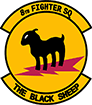
On May 12, 1960 the squadron emblem was approved, a golden yellow disc within a narrow black border, a black sheep, his eye white, standing on a red lightning flash fesswise, abased, the lightning pointing to dexter, its extremities extending be- yond the border on either side. Motto: Above the emblem, on an Air Force golden yellow scroll, edged and in- scribed black, "THE BLACK SHEEP".
Awards
Distinguished Unit Citations World War II: Australia (Aprll 20, 1942–August 25, 1942) Papua (September 30, 1942–January 23, 1943), New Guinea (May 14, 1943), Philippines (October 27, 1944–December 7, 1944).
Philippine Presidential Unit Citation
Distinguished Unit Citations: Korean War: Korea (July 2, 1950–November 25, 1950)
Republic of Korea Presidential Unit Citations: Korea (July 2, 1950–February 7, 1951), Korea (February 8, 1951–March 31, 1953)
Commanding Officers (C.O.)
Captain R. D. Van Auken (January 15, 1941–March 31, 1942)
Captain Allison W. Strauss (April 1, 1942–April 27, 1942) †
References
AFHRA - History Highlights of the 49th Fighter Group 1941 to 1946
Combat Squadrons of the Air Force World War II (1982) pages 47-48 (8th Fighter) [PDF pages 59-60]
Protect & Avenge The
49th Fighter Group in World War II (1995) by S. W. Ferguson & William K. Pascalis
49th Fighter Group Aces of the Pacific Aviation Elite Units 14 (2004) by by William Hess
Air Force Historical Research Agency (AFHRA) - 8 Fighter Squadron
|