|  |
|
| |
|
| Missing In Action (MIA) | Prisoners Of War (POW) | Unexploded Ordnance (UXO) |
| Chronology | Locations | Aircraft | Ships | Submit Info | How You Can Help | Donate |
|
| USN Independence-class Light Carrier 13,000 Tons 622' 6" x 71. 6" x 109' 2" 22 x 40mm AA 16 x 20mm AA 45 carrier aircraft 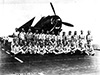 USN March 1944 |
Ship History Built by New York Shipbuilding Corporation, Camden, New Jersey. Laid down June 2, 1941 as a Cleveland-class light cruiser to be named USS Tallahassee (CL-61). On February 16, 1942 reclassified as Independence-class Light Carrier to be designated CV-23. On March 31, 1942 named Princeton as the fourth ship in the Navy for the Revolutionary War Battle of Princeton in Princeton, New Jersey. Launched October 18, 1942 as USS Princeton sponsored by Margaret Dodds, wife of Princeton University president Harold Dodds. Commissioned February 25, 1943 in the U.S. Navy (USN) at Philadelphia with Captain George R. Henderson in command. Afterwards, departs on a shakedown cruise in the Caribbean. On July 15, 1943 reclassified as CVL-23. Embarks Air Group 23 and departs via the Panama Canal bound for Pearl Harbor. Wartime History On August 9, 1943 arrives Pearl Harbor and joins Task Force 11 (TF-11). On August 25, 1943 departed Pearl Harbor bound for Baker Island as part of Task Group 11.2 (TG 11.2) commanded by Rear Admiral A. W. Radford aboard Princeton as his flagship. On September 1, 1944 provides air for the capture of Baker Island. Her planes continue to provide air cover for the next two weeks and shot down a H8K2 Emily flying boat Afterwards, Princeton rendezvoused with Task Force 15 (TF 15) and conducts strikes on Makin and Tarawa then returns to Pearl Harbor. In the middle of October 1943 departs for Espiritu Santo. On October 20, 1943 joins Task Force 38 (TF 38). On November 1, 1943 Task Force 38 (TF 38) USS Princeton and USS Saratoga aircraft participate in "Operation Shoestring 2" to strike Buka Airfield on Buka Island and Bonis Airfield in northern Bougainville to cover the U.S. landings at Torokina. During the raid, the force was within thirteen miles of Bougainville and the airfields were almost visible from the carriers. Lost during the two days of attacks are F6F Hellcat 25814 (rescued), F6F Hellcat 66021 (MIA) and November 2, 1943 lost are TBF Avenger 24071 (MIA) and TBF Avenger 24176 (MIA). On November 5, 1943 her planes strike Rabaul. On November 11, 1943 her planes again strike Rabaul. On November 19, 1943 with fast carriers of Task Force 50 (TF 50) her planes strike Nauru Airfield. Afterwards, steamed northeast, covered the invasion force en route to Makin and Tarawa. After exchanging operational aircraft for damaged planes from other carriers, got underway for Pearl Harbor and to the west coast. Underwent an overhaul at Bremerton, Washington. On January 3, 1944 departed for Pearl Harbor and rejoined the fast carriers of Task Force 58 (TF 58). On January 19, 1944 departs with Task Group 58.4 (TG 58.4) for strikes on Wotje and Taroa (29 January–31 January) to support amphibious operations against Kwajalein and Majuro. Her planes photographed the next assault target, Eniwetok, 2 February and on the 3rd returned on a more destructive assignment - the demolition of the airfield on Engebi. For 3 days the atoll was bombed and strafed. On the 7th, Princeton retired to Kwajalein only to return to Eniwetok on the 10th-13th and 16th-28th, when her planes softened the beaches for the invasion force, then provided air cover during the assault and ensuing fight. From Eniwetok, Princeton retired to Majuro, thence to Espiritu Santo for replenishment. On 23 March, she got underway for strikes against enemy installation and shipping in the Caroline Islands then made strikes against Palau, Woleai and Yap. On March 30, 1944 twelve F6F Hellcats took off on a fighter sweep and strafing mission over Peleliu Airfield on Peleliu Island. Two of the Hellcats aborted the mission due to mechanical failures. Over the target, the formation spotted a formation of 15-20 Zeros and intercepted. Shot down was F6F Hellcat 40653 (MIA). Afterwards, replenished at Majuro. On April 13, 1944 departs Majuro bound for western New Guinea. On April 21, 1944 until April 29, 1944 her carrier planes provide air cover over Hollandia. Afterwards, the carrier transits the International Date Line. On April 29, 1944 to April 30, 1944 her carrier planes strike Truk. On May 1, 1944 her planes strike Ponape. On May 11, 1944 returns to Pearl Harbor for a brief refit. On May 29, 1944 departs Pearl Harbor bound for Majuro and rejoins the fast carriers bound for Marianas and supports the landing on Saipan. Between June 11, 1944 to June 18, 1944 her carrier planes strike targets on Guam, Rota, Tinian, Pagan, and Saipan then steams westward to intercept a Japanese fleet reportedly en route from the Philippines to the Marianas. During the Battle of the Philippine Sea, her carrier planes claimed 30 kills and her anti-aircraft guns claim 3 plus one assis. Returning to the Marianas, Princeton again struck Pagan, Rota and Guam, then replenished at Eniwetok. On July 14, 1944 departs with the fast carriers and returns to the Marianas and provides air cover for the assault on Guam and Tinian. On August 2, 1944 the force returns to Eniwetok for replenishment then steams for the Philippines. En route, her carrier planes strike Palau. On September 9, 1944 and September 10, 1944 her carrier planes strike airfields on northern Mindanao. On September 11, 1944 her carrier planes strike the Visayas. Then return to Palau to support the assault then returns to the Philippines and her carrier planes strike Clark Field and Nichols Field on Luzon. Afterwards, the fast carriers withdraws to Ulithi. In early October 1944, sories and her carrier planes strike airfields, installations and shipping in the Nansei Shoto and Formosa area in preparation for the invasion of the Philippines. On October 20, 1944 Task Group 38.3 (TG 38.3) including Princeton are operating off Luzon and launch carrier planes to strike airfields to prevent Japanese land based aircraft from targeting the Allied invasion force in Leyte Gulf. Sinking History On October 24, 1944 at the start of the Battle of Leyte Gulf Japanese planes from Clark Field and Nichols Field spotted Task Group 38.3 (TG 38.3). Shortly before 10:00am a single D4Y Judy came out of the clouds above Princeton and an altitude of 1,500' released a bomb that hit between the elevators, crashed through the flight deck and hangar then exploded causing fires that quickly expanded. Further explosions caused smoke and flames on the sides of the island to the stern. Immediately, screening warships including destroyer USS Irwin (DD-794) and light cruiser USS Birmingham (CL-62) came to her aid. Coming to her aid, USS Irwin (DD-794) came along her port side and provides rescue and fire-fighting assistance despite raging flames, violent explosions, falling debris, and exploding shells. Despite dense black smoke and choppy seas, she rigged hoses and fought fires in the forward hangar deck. For the destroyer's actions, Irwin earned a Navy Unit Commendation. At 3:24pm, another, much larger explosion, possibly the bomb magazine, blew off the carrier's stern and the after flight deck. USS Birmingham (CL-62) that came alongside to fight fires, suffered heavy damage and casualties. Irwin immediately dispatched boats and her men dived into the seas to help rescue survivors. Though damaged herself, the destroyer stood at close quarters until she had rescued 646 men from the sea and from the carrier's deck. The rescued crew were packed like sardines aboard the destroyer. Meanwhile, the efforts to save Princeton continued. At 4:04pm the fires were out of control. Boats were requested to take off remaining personnel. Shortly after 5:06pm, USS Irwin (DD-794) began to fire torpedoes at the burning hulk. At 5:46pm, after the Irwin's torpedoes turned around and chased Irwin, USS Reno (CL-96) relieved Irwin and at 5:49pm the last, and biggest explosion occurred. Flames and debris shot up 1,000' to 2,000' into the air. Princeton's forward section was gone and her after section appeared momentarily through the smoke. By 5:50pm she had disappeared and sunk. Aboard, 10 officers and 98 sailors were lost in the attack the aftermath. Rescue A total of 1,361 of her crew were rescued including 646 by USS Irwin (DD-794). R. Gallatin, 19 years old at the time recalled: "In a way, it was a miracle that so many men could be saved as well as myself. The ship was a burning inferno!" Awards For her World War II service, Princeton earned nine battle stars. References Naval History and Heritage Command (NHHC) - Loss of USS Princeton (photos) Naval History and Heritage Command (NHHC) - U.S.S. Princeton (CVL23) Loss in Action Battle for Leyte Gulf 24 October 1944 NavSource - USS PRINCETON (CV-23) later CVL-23 (photos) Contribute
Information |
| Discussion Forum | Daily Updates | Reviews | Museums | Interviews & Oral Histories |
|